A seventh arm axis can help when the torch has a usable approach but the robot's elbow or another arm link cannot clear the surrounding assembly. It does not make an unreachable joint reachable in every situation. The distinction becomes easier to understand by working through an obstructed weldment rather than comparing axis counts in isolation.
In this Article
- Six tool coordinates and seven arm joints
- Worked example: a bracket inside a fabricated frame
- Comparison of three different obstructions
- Where the production benefit comes from
- What would constitute useful proof?
Six tool coordinates and seven arm joints
A welding torch needs a position in space and an orientation. For a general rigid-tool pose, that means three position coordinates and three orientation coordinates. A conventional six-axis arm can control those requirements within its usable workspace. It may have several distinct joint configurations for the same pose; it is not limited to one posture everywhere.
A seven-joint arm adds kinematic redundancy. It can have a range of elbow arrangements for a given tool pose, subject to joint limits and other constraints. That is the extra freedom Kassow uses. The practical opportunity is to choose an arm arrangement that suits the surroundings without changing the required torch pose.
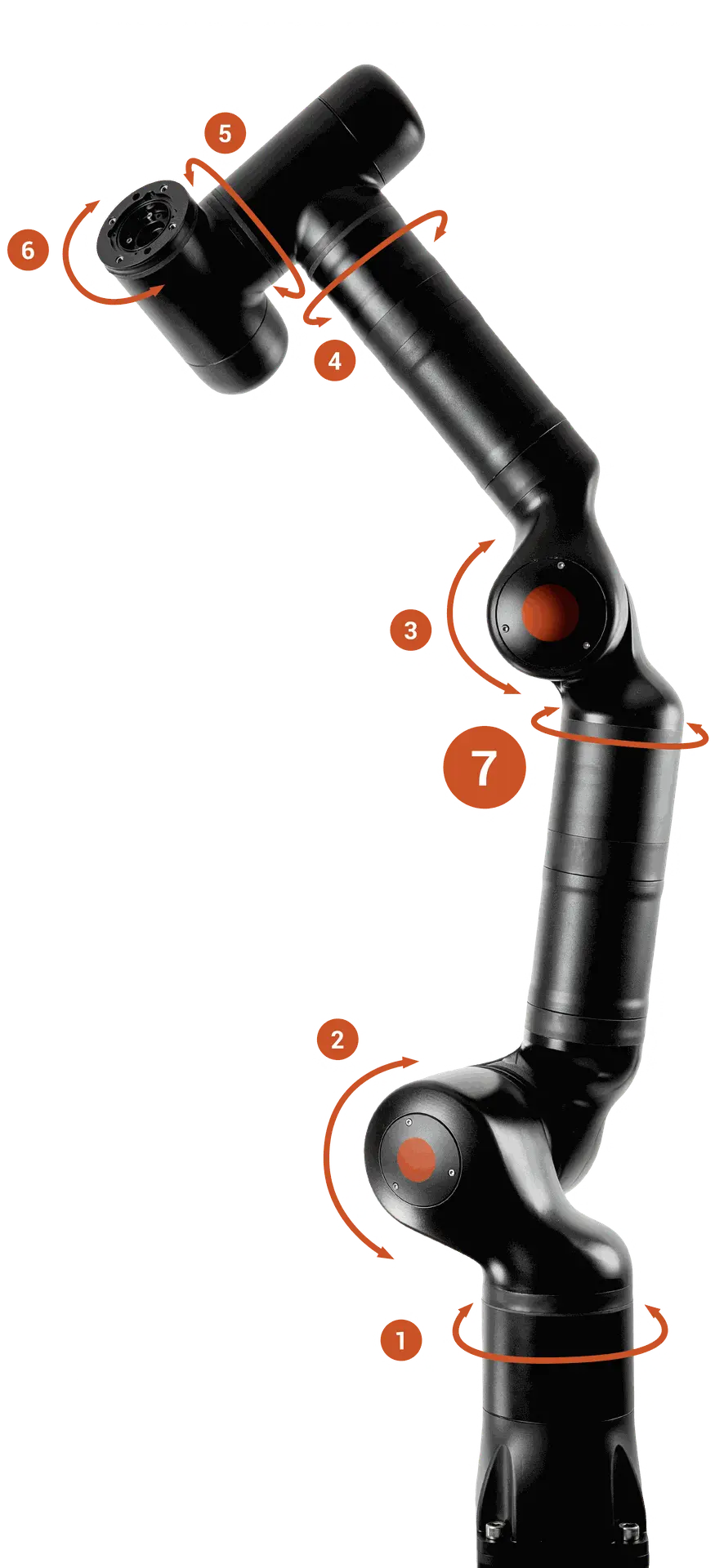
Kassow arm diagram from Spartan's existing media library. The seventh joint is inside the arm, not an external track.
Worked example: a bracket inside a fabricated frame
Consider a hypothetical frame with an internal bracket, a nearby crossmember, and a clamp outside the joint. There is an opening large enough for the torch. This is an explanatory example, not a report of a Spartan test.
The six-axis robot reaches the seam's start with the required torch orientation, but an arm link approaches the crossmember later in the path. Changing the arm configuration may resolve that interference. If no suitable configuration covers the path, the process may need a different robot mounting position, clamp location, or part orientation.
With a seven-axis arm, the additional elbow freedom provides another option to investigate: can the elbow move away from the crossmember while the torch follows the required seam? If so, the access problem may be solved without the same rearrangement. The extra joint supplies an option, not proof that the example will work in a specific cell.
Comparison of three different obstructions
| What blocks the operation? | What seven-axis articulation may change | What still has to be resolved |
|---|---|---|
| An arm link approaches the crossmember | Another elbow configuration may clear it | Clearance across the entire path, including entry and exit |
| The torch body cannot fit through the opening | Moving the elbow does not shrink the torch | Tool geometry, part orientation, or another production method |
| The seam lies outside the usable reach | An extra joint is not automatically more reach | Robot model, mounting position, and workpiece presentation |
These are different engineering problems. Treating all three as an axis-count problem can produce a misleading equipment decision.
Where the production benefit comes from
Suppose one demonstrated arrangement can weld the bracket and adjacent seams in the planned setup, while another requires a separate presentation. The benefit to investigate is the handling and work that arrangement avoids. It is not automatically faster arc travel or improved weld quality.
The coverage comparison should include all required seams and the welds left manual. A robot that completes one difficult seam but leaves most of the assembly elsewhere may have a different value from a configuration that supports the whole repeat sequence.
What would constitute useful proof?
Use the real torch package, realistic obstructions, and the required tool orientation. Verify approach, welding motion, departure, and travel between welds. An animation or dry motion can establish aspects of access; weld acceptance requires its own evidence. Neither a still photo nor a robot touching both seam endpoints proves the complete production method.
Spartan's seven-axis approach is relevant to this kind of geometric problem. The next conversation can focus on the marked obstruction and required weld coverage, rather than a broad claim that seven axes always beat six.
Related Reading
- 7-Axis vs 6-Axis Cobot Welding: Which Is Better for Fabrication Shops?
- Tight Fixtures in Cobot Welding: Why Weld Access Matters
Discuss Your Welding Application
Works Cited
Kassow Robots. "Frequently Asked Questions." Kassow Robots, https://www.kassowrobots.com/faq. Accessed 14 Sept. 2026.
Elias, Alexander J., and John T. Wen. "Redundancy Parameterization and Inverse Kinematics of 7-DOF Revolute Manipulators." NASA Technical Reports Server, https://ntrs.nasa.gov/citations/20240008776. Accessed 14 Sept. 2026.